VOICES FROM THE FIELD
A field account from the Indus Delta — where land, memory, and identity are disappearing together.
This account was recorded during a field visit to the Indus Delta region of Sindh, Pakistan. It is part of Parindey’s Awami Dastaan participatory storytelling initiative, documenting the lived experiences of climate-affected and displaced communities.
Author: Shahanshah Hussain
Sunken eyes. Hobbling painfully. Smiling without pause. A strange mixture of emotions marks the people here. Who are they? What is their story? But most importantly: why the suffering?
I set out on my bike from Karachi to Gharo, where I met Zuhaib. He had kept our destination a deliberate surprise, offering no hints. From Gharo, two students researching the Indus River joined us. After a fresh desi breakfast, we mounted our bikes and headed toward what felt like a chamber of secrets, unknown, unannounced. Every time I asked Zuhaib where we were going, he would simply reply, “Everything you see is the destination. Just observe.”
Trying hard to understand what he meant, I reflected on everything I had seen since leaving Karachi. Barren land that was all. I had never witnessed stretches of earth so completely devoid of greenery or crops. Getting impatient with each passing kilometer, I began to theorise: perhaps we were here to uncover what had stolen the fertility from these fields. Unable to arrive at any clear answer, I let my imagination wander, casting myself as a Disney prince on a sacred mission to break some terrible spell and free the land from a many-headed monster.
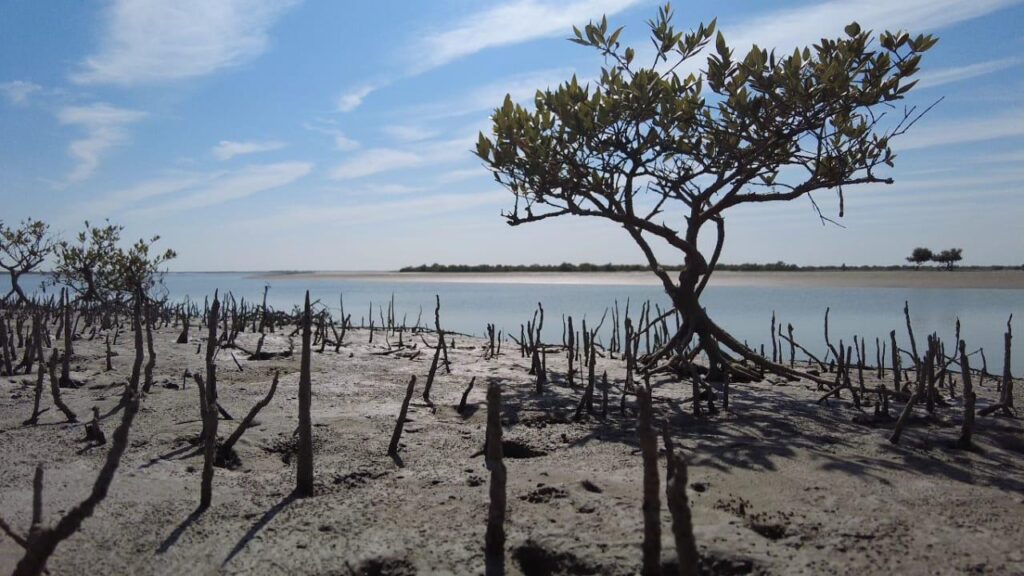
After several hours of riding through dead land, small lakes, scattered remnants of life, sparsely populated villages, and a landscape that was grievingly beautiful in its desolation, interrupted only by a broken bike chain, luckily in front of a mechanic’s garage, we reached Baghaan. Half a day had passed since leaving Karachi, yet I had seen no crops at a time when the rest of Sindh was alive with the chaotic beauty of harvest. Here, there was only dust.
The journey continued. Our hosts awaited us, and so did I, filled like a volcano, wanting someone to explain why there were no crops for nearly a hundred kilometres, why no children played in the fields, why the earth cried of thirst while people died of hunger.
Riding through dramatic roads lined with tall weeds and shadowy trees, the mighty Sindhu suddenly appeared before us, though not so mighty as I remembered from my childhood on its banks in Sukkur, my hometown. Looking at it, I recalled Shah Abdul Latif Bhittai, as he described the dancing Sindhu:
دائشت دام درياھ مي، جتي جايون جانارن،
نڪو سنڌ سير جو، مپو نھ ملاحن،
درندا درياھ مي، واڪا ڪيو ورن،
وڋا بيڑا بار مي، ھلئا ھيطي وجن،
پريزو پيدا نھ ثيئي، ڪو تختو منجھان تن،
ڪو جو قھرو ڪن مي، وئا سي نھ ورن،
اتي اتارن، اچي ساھڑ سير لنگھائيين
“There is a tremendous rise in the river’s level, such that the boatmen are lost as to its location and depth. The water creatures shriek and dart hither and thither in search of prey. The water is so deep that entire boats sink without a trace.”
Everything seemed alive at first glance, fishermen unloading boats filled with fish, trucks ferrying the catch to market, the Sindhu dancing as it fed its dependents. But there was a melancholy beneath it all. Before us was the Khobar Creek, which still enjoyed a flow of fresh water and the fish it brought. Here I met Zahid Sakhani or “Rais,” as the local men called him, meaning chief.
Originally from Kharo Chan, Zahid had been forced to migrate from his hometown due to the unbearable scarcity of resources caused by the disruption of the Sindhu’s flow. He became our companion for the journey ahead. After he had introduced himself, Baghaan, and Kharo Chan in detail, I could not help but ask what had happened to this place. He said he would answer that question shortly. First, we had to reach Aatharki, a tidal island just a few minutes from Dhaandho by boat.
Loading our bikes onto a patan, a flat ferry boat resembling a Viking longship — we sailed for about fifteen minutes and reached Aatharki. What a sight. The shimmering Sindhu caught the setting sun and turned the river into a blazing, fiery mirror. Zuhaib took off his headscarf and spread it on the ground. We settled to take in the mesmerising moment.
I repeated my unanswered question. Though I could see that Zahid had slipped into nostalgia, his tearstained face swollen with grief, I still needed to hear it. Silence broke when he finally spoke.
“I am no analyst. I cannot give you statistics or cite the experts who come here to explain what happened to my land. But I have a story to tell.
There was a lion who was captured by a circus master and forced to eat grass, so he could be made into a spectacle. The lion resisted — he was the king of the jungle, a meat eater, and he would not surrender his nature. Days of hunger passed. Eventually his logic began to wear down his pride: what harm could come from eating grass? Powerful animals like the elephant survived on it. So he agreed.
But then the master said: now you must also make the sound of a cat. The lion was enraged. He refused again. And again, hunger broke his resolve. He practised, he surrendered, he ate his grass. He grew old in the circus, and the masters — now confident — went back to the jungle and enslaved the entire race of lions. But enslaving the lions was not just the lions’ loss. It meant the jungle itself was now defenceless.”
Zahid paused for a long time, looking into a world only he could see, perhaps the only one still suffering from the weight of his own memory. Then he continued.
“Brother, had the lion king not surrendered to his hunger, had he stayed firm, had he thought of his people, the entire race of lions would never have faced this exploitation. Similarly, had the people before us understood the government’s intentions, had they anticipated the plans to build large dams and divert our river to water corporate farms, had they resisted even if it meant dying of hunger, had they not surrendered, I would never have had to leave my village. I would never have left my parents’ graves with no one left to pray there.
Now, the masters are confident we cannot resist. We were betrayed by our own people, the representatives we sent to the assemblies. And so it has been years since I last visited my mother’s grave, my father’s house, the neem tree I played under with my friends. It is all gone. Everything feels like a horrifying dream.”
Zahid continued —
“The situation of the Delta is worsening every day and it demands our attention. The once-prosperous Delta now carries only scars and memories, shrinking because capitalism does not care about anything but profit, even at the expense of my people. But the Delta will not die alone. The native people, the marine life, the cultural heritage of this land, all of us share the same coffin. We cannot be separated from each other. We are essential to one another, and any threat to one part is a threat to all. The death of one is the death of all.
Until the Sindhu is allowed to live its rightful life, we have vowed to continue our struggle, by whatever means necessary. For we have lost all reason to be happy. This land is so saddened by the condition of the Delta that even the days begin with a melancholic dusk.”